Education (K-12)

Improve the comfort and safety of your school with energy efficiency upgrades. 
According to the U.S. Department of Energy, K-12 school districts spend nearly $8 billion annually on energy costs, the second largest expense after teacher salaries. With efficiency upgrades, schools have the opportunity to reduce energy use and create a comfortable learning environment for teachers and students.

In addition to incentives and project support, the Sponsors of Mass Save offer K-12 schools a variety of resources, like teacher trainings and energy-saving fundraiser programs.

Key Energy-Saving Opportunities

The following studies may be a good starting point to evaluate cost and energy savings for your Education (K-12) sector facility.

  • Portfolio Prioritization Plan: The Portfolio Prioritization Plan is a quick, high-level analysis designed to assess energy usage and building system performance for a set of facilities within your building portfolio.
    LEARN MORE

  • Scoping Study: During a scoping study, an Energy Expert evaluates all facility areas and systems like building controls, insulation, heating and cooling equipment, lighting and more to identify energy-saving opportunities.
    LEARN MORE

  • Comprehensive Business Assessment: Comprehensive Building Assessments take a deeper dive into energy savings and reducing a building’s carbon emissions with electrification and energy efficiency measures.
    LEARN MORE

  • Focused Study: Focused Studies provide precise cost, savings and emissions impact estimates for selected energy efficiency or decarbonization measures, along with documentation required to complete a Mass Save custom incentive application.
    LEARN MORE

1. Efficient Lighting Design
Energy-efficient lighting in education environments can provide a better student and faculty experience. Indoor and outdoor LED lighting and controls use light and energy more efficiently, saving money and energy. LED lightbulbs are long-lasting and require fewer changes, freeing up maintenance time.


Learn More 
2. Building Insulation & Weatherization Upgrades
Building envelope upgrades (increasing insulation, air-sealing, etc.) can be an effective way to improve the comfort of a school. Making improvements helps to both regulate the indoor climate (temperature control, air quality) and protect students and faculty from the outdoors (drafts, condensation).

Learn More
3. Heating & Cooling Equipment Upgrades
Heating and cooling are often the largest energy expense for schools. By properly maintaining equipment or upgrading to high-efficiency systems, your school can enjoy long-term reduced energy usage, decrease equipment maintenance time, reduce greenhouse gas emissions, and create a comfortable environment for your students.

Learn More
4. Water Heating Upgrades
Hot water is used every day in a school, and it’s a cost that can add up quickly. Upgrade to higher-efficiency systems to lower heating expenses, decrease equipment maintenance time, and lower greenhouse gas emissions.


Learn More

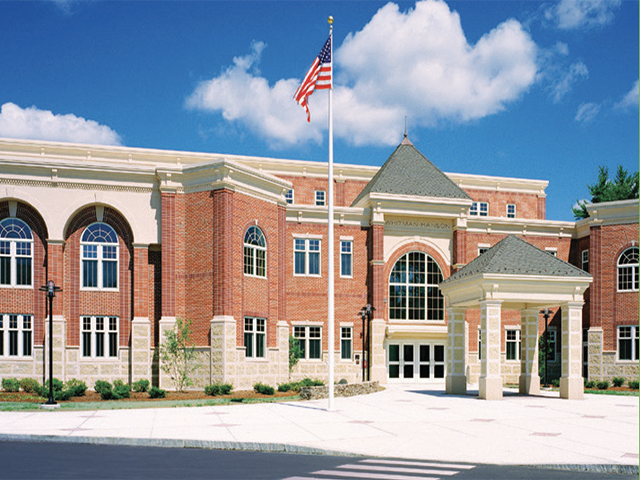
Case Study: Whitman-Hanson Regional High School

By incorporating sustainable design principles when building their school, this high school saw a carbon reduction of 5,789 tons.

Not Sure Where to Start?

Answer a few questions to discover your next steps to save energy.

Find your path to savings