Energy Efficiency

Case Study

Finch Cambridge

Brought to you by Eversource

Highlights

98
Number of units
190,519 kWh
Annual electric savings
3,799 therms
Annual natural gas savings
572,818 gallons
Annual H2O savings
346,614 pounds
Annual CO2 savings
3,799 therms
Annual natural gas savings

About Finch Cambridge

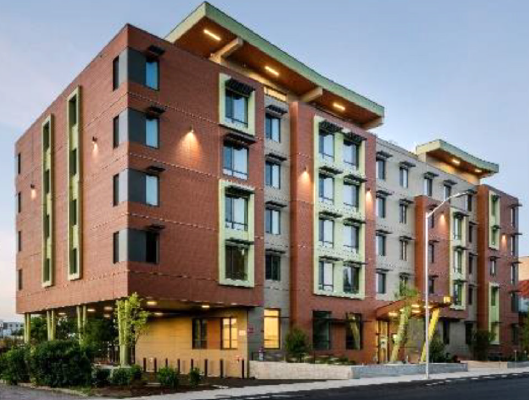
Finch Cambridge is an ultra-efficient Passive House certified six-story building and the largest Passive House project completed to date in New England. Developed by Homeowner’s Rehab, Inc., with a focus on efficiency, climate resilience, and residential comfort and health, the 111,450-square-foot building has 98 units, all deed-restricted to be affordable for low-income tenants. In addition to achieving PHIUS+ 2015 certification from the Passive House Institute US (PHIUS), the project has also been certified by Enterprise Green Communities and FitWel.

The envelope has minimal thermal bridges with continuous roof insulation (R55) and walls, including R21 in the wood stud cavities plus R9 continuous insulation outboard. The envelope air tightness was tested per ASTM E-779 (whole building blower door), achieving an exceptional 0.073 CFM@75 pascals per square foot of envelope (equivalent to 0.41 air changes per hour [ACH] @50 pascals) and outperforming the PHIUS+ certification requirement.

Heating and cooling are provided via a central variable refrigerant flow (VRF) system (11.9 EER average), and fresh, filtered air is delivered through a central energy recovery ventilation (ERV) to common areas and each residential unit. The domestic hot water system uses a 96% efficient condensing central boiler with an aquastatcontrolled recirculation loop and low-flow fixtures to minimize heat loss.

Sponsor involvement

The Sponsors of Mass Save® provided Residential New Construction incentives to help cover the incremental costs to upgrade the building envelope, air sealing, and mechanical equipment. The incentives from the Sponsors of Mass Save reduce the building owner’s annual electric consumption by 70%, thereby reducing operating costs for the life of the building.
Development team

  • Developer: Homeowner’s Rehab, Inc.
  • Architect: ICON Architects
  • MEP Engineer: Peterson Engineering
  • Sustainability Consultant: New Ecology, Inc.
  • Contractor: NEI General Contracting
  • Certified Passive House Consultant: Linnean Solutions, Inc.
  • PHIUS+ Rater: JSR Adaptive Energy Solutions Inc.

Green features

  • Certifications
    – PHIUS+ 2015
    – FitWel
    – Enterprise Green Communities

  • Building envelope
    – Triple-pane, fiberglass-frame windows with advanced Low-E coatings and argon; average U-factor of 0.219 and average solar heat gain coefficient (SHGC) of 0.32

    – Wood-stud framing with R21 spray applied fiberglass insulation in 5.5-inch stud cavities, with 2 inches of continuous mineral wool insulation outboard of the sheathing with an R8.6 rating

    – Low-sloped, single-ply fully adhered roofing system with tapered polyisocyanurate rigid insulation providing an effective R-value of R30; plus 3.5 inches of closed cell spray foam (R24.5) under the roof deck for a total roof insulation value of R54.5

    – Air-sealed envelope tested per ASTM E-779 (whole building blower door) achieved exceptional 0.0731 CFM@75 pascals per square foot of envelope


  • Residential and common area HVAC
    – Mitsubishi PURY VRF system (11.9 EER average)
    – Ducted distribution within each residential unit
    – Central ERV providing fresh, filtered air to common areas and each residential unit

  • Domestic hot water
    – Central natural gas-fired condensing water boiler
 
  • Residential hot water fixtures
    – Showerheads and wands at 1.5 gallons per minute
    – Lavatory faucets at half a gallon per minute
    – All other faucets at 1.5 gallons per minute

  • Lighting
    – High-efficiency LED lighting for common and residential areas
    – Advanced lighting controls in all common areas, including corridors, lobbies, and stairs

  • On-site renewable energy
    – 105 kW solar PV system, which covers about 20% annual electric consumption