Energy Efficiency
Case Study
All-Electric Home Acton, Massachusetts
Brought to you by Eversource
Highlights
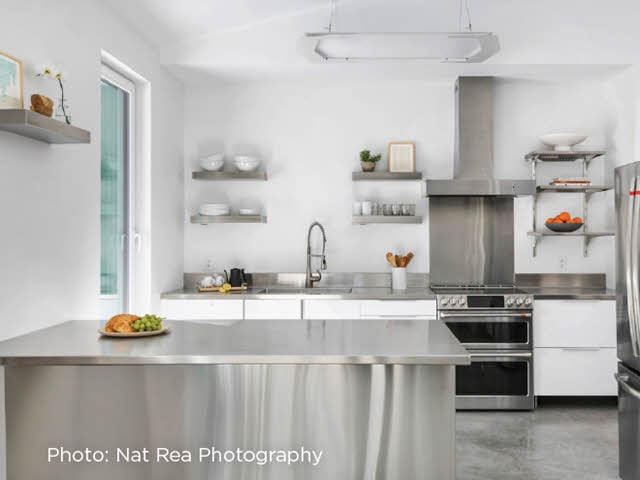
About All-Electric Home Acton, Massachusetts
Located in the woods of Acton, MA, this net-zero single-family home features innovative construction materials and high-performance HVAC equipment and employs Passive House design principles. The house achieved a HERS Index of 25 before on-site generation was factored in and an incredible -15 with the solar panels accounted for.
Challenge
When setting out to build their new home, the owners wanted to be as intentional as possible about achieving a high level of energy efficiency and a low carbon footprint. As such, they targeted Passive House certification from the beginning and knew they wanted to build a home free of fossil fuels and spray foam. The two-bedroom, 1,600-square-foot modern take on a slab ranch-style home has a super-insulated envelope constructed with low-embodied carbon materials: The only foam product— expanded polystyrene (EPS) rigid board—is under the slab; the rest of the home uses dense-packed cellulose, Mento 1000 house wrap, and Gutex wood fiberboard continuous insulation. Triple-pane Schüco casement windows with a U-factor of 0.16— and “lots of tape!”—help to complete the virtually air-tight envelope of this home, which measured an astonishing 0.59 ACH50 at its final blower door test.
Outcomes
To make sure the air in the home is not only comfortable, but also healthy, the design includes a Zehnder Comfair Q350 energy recovery ventilation (ERV) system to compliment the Mitsubishi Hyper-Heat ducted heat pump. Incredibly, this home only required a 1.5-ton outdoor unit to service the home’s entire heating and cooling needs. A 65-gallon Bradford Aerotherm heat pump water heater adds to the energy efficiency of the mechanical design. The home was also designed for resilience via a 6.8-kW solar array on the metal roof of the home, combined with a Tesla Powerwall battery storage system to provide backup power during power outages.
The building owner explained, “My main motivations for commissioning this house were (1) minimize my living impact on the environment by reducing energy consumption; (2) avoid large utility costs; and (3) as a demonstrator project to inspire others to do the same.” The owner added that it was “a great learning experience, having been able to witness the construction from beginning to end. I have a deep appreciation of the technology, engineering, skills, and care required to build such a house and can say that the end product is totally worth it.”
Since moving in, the owner reports that the house has performed “admirably,” and even went on to say that “The temperature uniformity and stability throughout the house even surpassed that of the research laboratory where I work!”
Green features
Certifications- PHIUS+ 2018 Source Zero
- EPA Indoor airPLUS
- U.S. Environmental Protection Agency (EPA) EnergyStar 3.1
- U.S. Department of Energy Zero Energy Ready Home
- Infiltration: Building envelope blower door tested, achieving an exceptional 0.59 ACH50
- Roof: Dense-packed cellulose (R-67)
- Walls: Wood-stud framing with spray-applied cellulose insulation (R-20) in 5.5-inch stud cavities, with 4” of Gutex continuous insulation (R-14) outboard of the sheathing
- Windows: Triple-pane, uPVC window frames with advanced Low-E coatings and argon, U-factor of 0.16, and a solar heat gain coefficient (SHGC) of 0.20
- Slab: EPS rigid board (R-27) under slab
- 18k BTU Mitsubishi ducted air-source heat pump (10.3 HSPF, 18.4 SEER)
- Zehnder ERV system supplying fresh, balanced, filtered air to each living space
- Appliances and lighting
- LED bulbs throughout
- Induction range
- Bradford Aerotherm 65-gallon hybrid heat pump water heater (3.46 EF)
- EPA WaterSense-certified fixtures
- 6.8-kW solar array (20 panels)
- Tesla Powerwall battery storage system
- Electric vehicle charging
- Electric
- Architect: ZeroEnergy Design
- Contractor: Adams + Beasley Associates
- HERS Rater: Advanced Building Analysis, LLC